Selecting Components for Packaging Machinery: Balancing Reliability and Cost Based on Functional Requirements
The core logic for selecting components for packaging machinery is not about "choosing the most expensive" or "using only imported parts," but rather about finding the optimal balance between reliability and cost for each functional level. A machine’s stability, precision, and failure rate are largely determined during the component selection phase. Below, we break down the key selection criteria across five categories: control, drive, sensing, pneumatics/safety, and food-contact materials.
Control and Interaction Layer: Do not skimp on the "brain." The PLC and touchscreen serve as the control core of the entire machine. The PLC handles logic control, while the touchscreen manages human-machine interaction. Generic or low-quality PLCs may suffer from program drift within just six months, making troubleshooting extremely difficult. In contrast, a high-quality PLC will display specific error codes on the screen when a fault occurs, allowing operators to resolve issues by simply consulting the manual. Reliable, mainstream brands include Siemens, Mitsubishi, Omron, and Delta. For touchscreens, the focus should be on interface logic rather than screen size; a well-designed system allows for quick product changeovers by requiring input for only a few parameters (such as bottle height and fill volume). Conversely, if an operator must navigate through three layers of menus to adjust a dozen different parameters, the system is prone to human error.
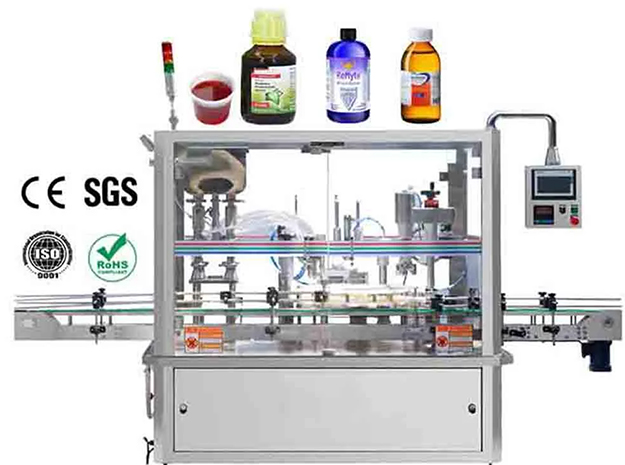
Drive and Execution Layer: In fully automatic liquid filling machines, precision is driven by servo systems, while speed is managed by variable-frequency drives (VFDs). A VFD controls motor speed, enabling smooth adjustments. Equipment lacking a VFD can only operate at full speed, which often causes liquids to foam or overflow during the filling process. Servo motors, meanwhile, determine the precision of dispensing or positioning; for high-precision applications—such as filling small doses of reagents—servo systems are essential, offering accuracy of approximately ±0.5%. Be wary if a supplier attempts to market stepper motors as having "servo-grade precision." A practical way to verify whether the drive configuration has been compromised is to request a live demonstration: the speed adjustment should be smooth and seamless, with no jerking or unusual noises, even when running at the lowest speed.
Sensing Layer: Sensors determine how "accurately" the machine perceives its environment. Photoelectric sensors, for instance, are used to detect whether a bottle is in the correct position, ensuring that the machine does not dispense liquid unless a bottle is present. Imported brands (such as Omron or SICK) offer positioning accuracy down to the millimeter, whereas generic, low-quality components may produce false readings when ambient lighting in the production facility changes. Liquid level sensors control fill heights; a deviation of even 1mm can result in inconsistent fill levels across an entire batch. Pressure sensors are critical for the isobaric (equal-pressure) filling of carbonated beverages; inaccurate readings can cause liquid to spray out during the filling process. Sensor selection must align with actual operating conditions—factors such as workshop lighting, material properties, and cleaning protocols all influence long-term sensor stability.
Pneumatics and Safety: Often the most overlooked areas, yet the most frequent sources of failure. Pneumatic components—such as solenoid valves, cylinders, and air preparation units—may cycle tens of thousands of times a day. Generic, low-quality parts often begin to leak air within just three months, disrupting the rhythm of the entire machine. SMC and AirTAC are considered the industry’s baseline standards; if a quote merely specifies "high-quality pneumatic components" without naming a brand, it is highly likely that generic parts are being used. Regarding safety interlock switches: if a hazard cannot be stopped instantly (e.g., high-speed rotating parts), a locking-type switch is required; if the hazard can be stopped immediately, a non-locking switch is sufficient. For facilities requiring washdown cleaning, an ingress protection (IP) rating of at least IP67 is recommended, with IP69K required for more demanding environments.
Food-Contact Surfaces and Structural Materials: Compliance is the absolute baseline. In food and liquid packaging machinery, components that come into direct contact with the product—such as feed hoppers, sealing molds, and material conduits—must be constructed from 304 or 316L stainless steel. These surfaces should be mirror-polished (Ra ≤ 0.8μm) to minimize residue buildup and microbial adhesion. Non-contact components, such as the machine frame and drive systems, should also be made of stainless steel or food-grade plastics to prevent corrosion or the risk of contamination from flaking coatings. For equipment destined for export to Western markets (such as the US or Europe), materials must also comply with relevant standards, such as FDA regulations or the Chinese national standard GB 4806.9. At Henan Mingtan, we specialize in the manufacturing and sales of packaging machinery. We offer a wide range of options for machine components—including brands like Siemens, Delta, and Schneider, as well as various domestic Chinese brands. Please reach out to us to discuss your specific requirements so that we can configure the ideal machine for your needs. We look forward to hearing from you.