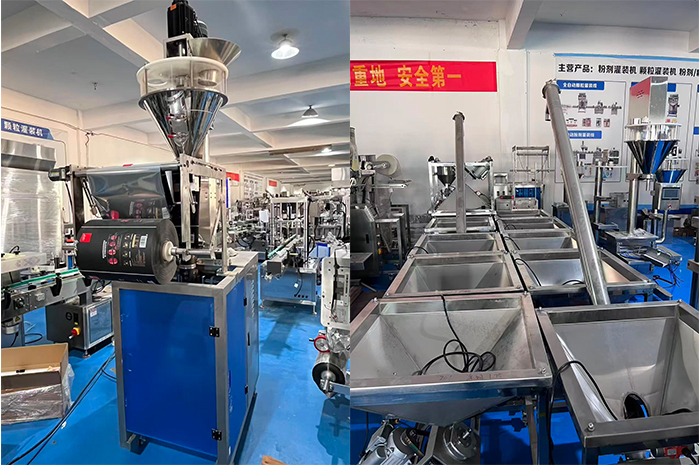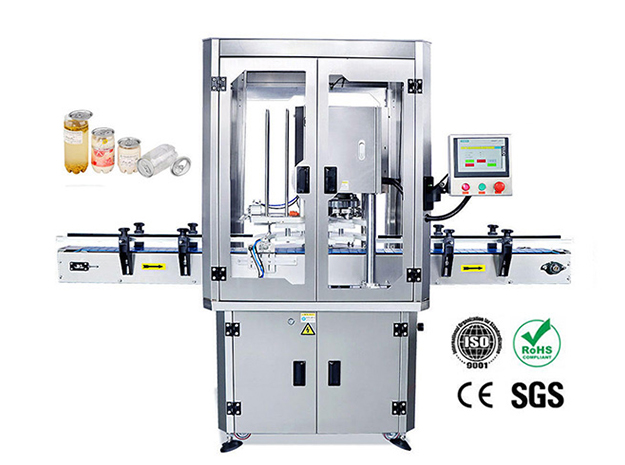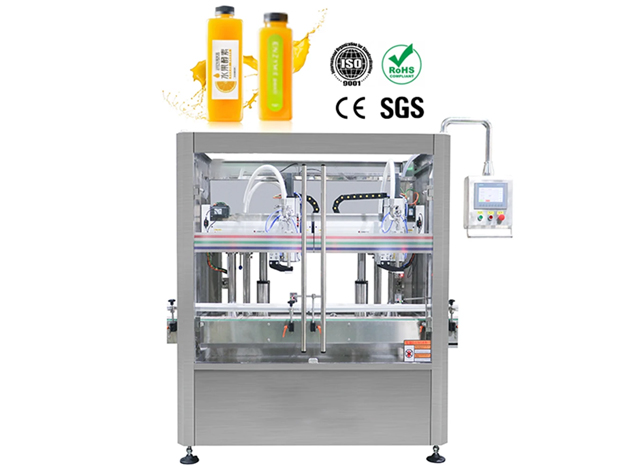
The precision challenge in powder packaging has long plagued manufacturers in the food, chemical, and pharmaceutical industries. Flour, milk powder, additives, toner—these materials vary widely in flowability and bulk density. Under traditional volumetric metering, per-bag errors of several grams to over a dozen grams are the norm. The reason fully automatic weighing powder packaging machines have become a key upgrade direction in recent years is that they shift feeding from "timed estimation" to "real-time weighing closed-loop control."
Dual-speed feeding and stop-drop compensation are the core logic behind the precision improvement.
The mainstream working method of weighing-type powder packaging machines is "fast/slow two-stage feeding + real-time weighing sensor feedback." Taking a powder weighing packaging control patent published in 2026 as an example, the system first approaches the target value rapidly at coarse feed speed. When the fed net weight reaches "target net weight minus switching margin," it switches to fine feed speed. The condition for stopping fine feed is when the net weight reaches "target net weight minus stop-drop." The "stop-drop" here is the critical variable: between the screw stopping and the material fully falling into the weighing hopper, there is still an airborne stream of material. The system must dynamically calculate this drop based on real-time feed flow rate and issue the stop command in advance. This logic makes single-batch metering precision significantly better than traditional fixed-advance schemes.
Actual equipment parameters confirm the maturity of this technical route.
Among mainstream market equipment, small-capacity models (1g–500g) achieve packaging accuracy of ≤±2% (below 100g) or ≤±1% (100–500g). For medium-to-large specifications (10kg–50kg), weighing-type powder packaging machines typically claim accuracy in the range of **±0.2%–±0.5%**, with some high-precision models for ultrafine powders reaching **≤±0.1–0.2%**. In terms of speed, small-bag models can reach filling speeds of 40–120 cycles per minute, while large-bag models run at 2–8 cycles per minute. The trade-off between precision and speed depends on material characteristics and screw parameter matching.
Dust control and anti-caking are the second battleground beyond weighing precision.
Powder materials generate dust easily during high-speed screw conveying, and dust adhering to weighing sensors or bag-clamping mechanisms directly interferes with metering accuracy. Current equipment solutions include: pneumatic bag clamping combined with pulse dust removal systems to create a negative-pressure sealed environment at the filling port; degassing designs for ultrafine powders that extract air from the bag during filling to prevent low actual net weight caused by material lofting; and anti-bridging or stirring devices installed in the hopper to prevent uneven feeding caused by material arching and caking. A patent authorized in 2025 also specifically designed a guided air-blowing structure between the packaging machine outlet and the downstream belt scale, ensuring bags fall accurately onto the weighing station and avoiding false rejections triggered by position deviation.
Three things to focus on when selecting equipment.
First, material characteristics determine screw parameters.Fine powders with good flowability and sticky powders prone to caking require completely different screw pitch, outer diameter, and feeding strategies. A supplier's claimed accuracy is calibrated under specific materials. Running your actual material through a trial—50 bags or more, recording the weight distribution—is more meaningful than reading a specification sheet.
Second, weighing sensor quality directly determines long-term stability.Mainstream equipment typically uses sensors from brands such as Mettler-Toledo, whose resistance to vibration interference and long-term drift control are the foundation for precision not "drifting" after two years of use.
Third, consider whether production line integration is needed. If you plan to connect vacuum feeding, automatic cartoning, or palletizing systems later, confirm during selection whether the equipment reserves communication interfaces and linkage signals. Discovering after purchase that a standalone unit cannot connect carries a retrofit cost far higher than planning ahead during selection.
The value of a fully automatic weighing powder packaging machine lies not in being "more advanced" than traditional equipment, but in turning "keeping per-bag error within contractual tolerance" from something that depends on operator experience into a reproducible, traceable system capability. For powder products, this shift directly relates to material cost accounting and customer acceptance rates.