Packaging powders and granules involves a task that appears simple but is notoriously difficult to execute perfectly: transforming an "approximate" weight into an "exact" amount for every single bag. Whether it’s coffee grounds, seasonings, powdered milk, laundry detergent, or feed additives—these materials vary significantly in their flow characteristics and bulk densities. When using traditional volumetric metering, the margin of error can easily range from several grams to over a dozen grams. Auger-based packaging machinery addresses this challenge by shifting the dispensing process from mere "estimation" to precise "control."
The core of an auger-based dispensing system is not just a rotating screw, but a multi-stage, progressive metering logic.
Consider a patented auger-dispensing design: the feeding mechanism is equipped with multiple augers, each calibrated for a different delivery capacity. If the target weight is 1,000 grams, the system begins with a high-capacity auger (designed for 100-gram increments) to rapidly dispense the bulk of the material, keeping the error within 10 grams. It then switches to a smaller-capacity auger (for 10-gram increments) to narrow the margin of error to 1 gram. Finally, a precision auger (for 1-gram increments) performs a "fine-tuning" step, bringing the weight deviation down to less than 0.1 grams. This "coarse adjustment via large auger, fine-tuning via small auger" strategy ensures high operational speed while achieving a level of precision unattainable with traditional single-auger designs. Furthermore, the inclined orientation of the auger serves an additional purpose: gravity keeps the material resting firmly against the screw. This prevents material near the discharge point from accidentally falling out due to the shifting or collapse of the material mass ahead of it—structurally eliminating a common source of error.Beyond this, precision is also embedded in the geometric parameters of the auger itself.
Since auger-based dispensing is essentially a form of volumetric metering, the consistency of the volume within each pitch of the screw directly determines the accuracy of the measurement. Variables such as the pitch, outer diameter, root diameter, and the shape of the flight (the blade) all influence the delicate balance between the quantity of material dispensed and the speed at which it is delivered. A concrete comparison illustrates this point well: when packaging 50g of cumin powder, using an auger with an outer diameter of 30mm and a pitch of 22mm yields an accuracy of ±0.5g in over 80% of cases, and ±1g in over 98% of cases. Conversely, if the pitch is increased to over 50mm—while keeping the same outer diameter—the dispensing speed does indeed rise, but accuracy drops to around ±3g. A larger pitch means more material is pushed forward per revolution; while this boosts speed, it also amplifies the volumetric fluctuations between each turn. In essence, the trade-off between "speed" and "accuracy" is largely determined the moment the auger parameters are selected.
Case Study: The Cost of Accuracy in Seasoning Powder Packaging
Last year, a company producing blended seasoning powders was using an older volumetric packaging machine to fill 50g portions of barbecue seasoning. The product had a high salt content and a flow characteristic somewhere between a fine powder and coarse granules; the old equipment resulted in a variance of about ±3g per bag. While 3g might seem negligible for a single bag, at a daily production volume of 20,000 bags, this adds up to tens of kilograms of excess or missing material—leading to inventory discrepancies during month-end stock reconciliation.
After switching to an auger-based packaging machine, the manufacturer configured the equipment with an auger featuring a 30mm outer diameter and a 22mm pitch, tailored to the specific properties of the material. During the commissioning phase, operators ran 200 bags and weighed each one; over 95% of the bags fell within a stable accuracy range of ±1g. This improvement yielded benefits beyond just material cost savings: with a more consistent fill, there was significantly less residual powder at the bag opening, which reduced the rate of defective seals and lowered labor costs associated with rework. The client subsequently ordered two more units of the same model—for a simple reason: the machine transformed "50g per bag" from a rough target into a reliable commitment that could be written into formal contracts.
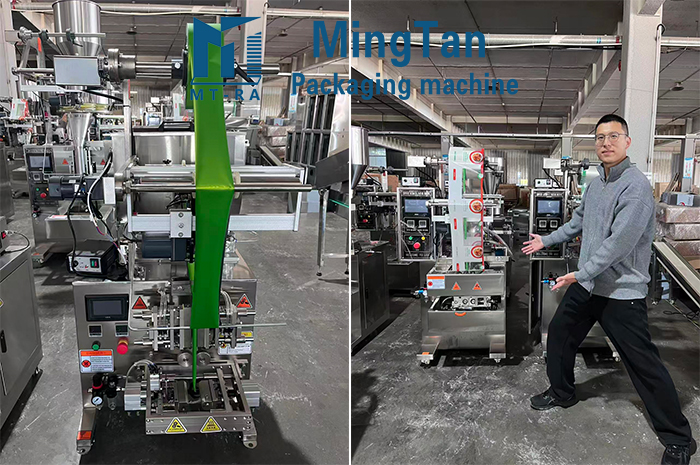
When selecting equipment, start by analyzing the material, then determine the parameters. The upper limit of precision for a screw feeder depends on how well the screw is matched to the specific material—it is not determined solely by the manufacturer’s nominal rating of "±0.5%." For instance, free-flowing granular materials and fine powders prone to clumping require entirely different screw configurations. At Henan Mingtan, we specialize in the manufacturing of equipment for packaging powdered materials. We can customize and configure the ideal machine to meet your specific filling requirements. You are also welcome to send us samples of your material, and we can conduct on-site testing for you. We look forward to hearing from you.